|
THE WILF MORTLY
PARADOX.
|
|||
| In the February edition of The Wheatsheet,
Phil Stevens published an article concerning the number of spokes in
cart wheels and why it has been observed that 14 appears to be the most
common arrangement. This, it seemed, had been causing some alarm in the
scientific community as it did not fit their preconception of how
circles are subdivided, that is by compasses or protractors. ie
scientific instruments.
As will be seen later in this article, spoked wheels were in existence many centuries before the advent of Euclidian geometry, around 300BC. I would like to extend this particular area of study to include wagons, carriages and other similar wheeled vehicles and carts.
|
|
||
|
|
The origin of spoked wheels is very ancient.
One of the earliest examples is represented in a painted clay model of
2000 BC. In Europe a well established tradition existed in the Iron Age,
commencing approximately 3000 years ago. One of the important features
of early wheels is the large number of spokes used. The Jejbjerg cult
wagon dated around 100 BC. had 4 wheels each of 14 spokes and the
construction was very similar to modern examples. The spoked wheel was a highly developed form and examples have been found in Europe, Egypt and throughout Asia as far as China, many 2 to 3 thousand years old. Development of the technology of the wheel, like much else was stimulated by military requirements. The lighter and stronger the construction the faster and more effective it would be in combat. The evidence for early spoked wheels comes largely from excavation of burial mounds where chariots and ceremonial vehicles were interred along with the tribal Chieftain. |
||
| Generally it was only the wealthy
and the military that would possess this type of vehicle. The humble agricultural vehicle of whatever type would still be constructed with solid wooden wheels and this remained so until the Late Middle Ages. It is about this time that the development of the cart and wagon as we know it really began. In Britain, these became extremely sophisticated vehicles. The number of spokes in a given wheel, compatible with strength for purpose, is a product, among other factors, of the circumference of the Nave (Hub). The span of the felloes (Rim) between the spokes, the diameter of the wheel and a workable loading height. |
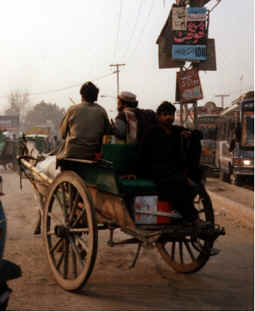
 Pakistani cart with wheels of 14 staggerred spokes
|
||
|
Whilst there would be much regional variation in
wagon and cart design to suit the purpose, terrain etc., the basic
notion holds true. So it is not hard to see that men with such highly
developed skills, who could make something as complicated as a wheel
would have no difficulty dividing the circumference of the nave with his
straddling dividers, initially done by trial and error, but largely by
eye.
|
|||
|
Observations and comments. |
|||
|
The study of The English Farm Wagon by J. Geraint
Jenkins shows that of the 67 wagons surveyed, 33 had a wheels of 12 and
10 spokes, 19 had wheels of 14 and 12 spokes and 15 had wheels of 12 and
12 spokes. (The first number is the rear wheel.) |
|
||
|
My own observations of this matter tends to suggest a
dominance of wheels with 14 spokes. The following details research to
date. Baltic States, Lithuania. Only wagons seen of a
primitive kind, 14-14 and 12-12. George Sturt. The Wheelwrights Shop. Cambridge
University Press.
|
|||