|
Daffodils
in the wind. |
||
| I wandered lonely as a cloud, That floats on high o'er vales and hills, When all at once I saw a crowd, A host, of golden daffodils; Beside the lake, beneath the trees Fluttering and dancing in the breeze. (William Wordsworth. 1770-1850 |
||
|
||
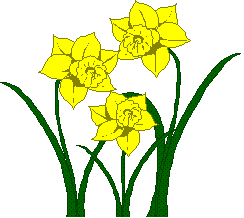 |
Did young William, I wonder, study the way in which these Daffodils fluttered and danced? He may have done, but I wonder if he observed the following. When Daffodils are in bud, they sway from side to side, or shake their heads, but when they are fully open they nod their heads. Why should this be? Well, I suggest that it’s all to do with vortex shedding, moments of inertia, centres of gravity, petal surface area and the stiffness of the stalks A few days before a Daffodil flower opens, the principle axis of the bud is horizontal, at right angles to the stalk. The bud is long and thin (torpedo shape) and has a centre of gravity about half way along it’s principle axis. | |
| As the wind blows past the
vertical stalk, so vortex shedding occurs, resulting in a side to side
oscillatory force on the stalk. This oscillatory force will cause the
stalk to sway from side to side, but because the combined centre of mass
of the stalk and bud is offset from the principle axis of the stalk, the
resulting motion is an angular oscillatory motion, thus the shaking
of the head.
When the bud opens, there are three significant effects on the flower dynamics. Firstly, the centre of gravity moves back (nearer to the stalk), secondly, the moment of the inertia increases and thirdly, the surface area increases. The net result of the first two effects is that the oscillatory motion is considerably reduced and, indeed, it is masked by another effect, which takes over. The increased surface area results in a force from the wind that bends the flower forward. As the flower bends forward the effective surface area of the petals reduces, and there comes a point where the air spills off the petals and a restoring force, due to the stiffness of the stalk, causes the flower to spring back. This whole cycle repeats itself again and again, thus the nodding of the head. Final thought, why do Daffodils have six petals? |
||
|
||
