|
He Spoke of Spokes!
|
|
| Many
years ago, probably about ten, I attended a leaving presentation at the
Marconi Research Centre, Great Baddow, to bid farewell to the Director
of Research, who was retiring. As with all these occasions, several of
his old working colleges were invited along and there was much
reminiscing, helped along with a few glasses of wine.
I was particularly pleased to see one chap there, Wilf Mortly, who I had not seen for about ten years, he was a mathematician, and for a brief period I had carried out some work for him when he was at Baddow. I asked him what he had been doing during his retirement and his answer was much more interesting than the usual. In fact his answer has left me, and several other regulars in this pub, with a conundrum which has still not been solved. So, those of you who have already been struggling with this may stop reading now, but those who like a challenge; read on. Wilf had been studying how our ancestors had divided up circles. There are many examples in ancient architecture where incredibly precise divisions of circles into uniform segments have been achieved; without the aid of modern surveying equipment. He had spent some time looking at various famous examples around the world and had written some papers on the subject, which were published in various scientific journals. I particularly remember him talking about Stonehenge. He had a theory about the postioning of the stones which he tried to explain it to me, but I must confess, his explanation soon went above my head. Anyway, eventually, he had run out of interesting architectural examples and he turned his attention to cart wheels. He began counting spokes. Every time he saw a cart wheel or picture of one, he would count the number of spokes. He found that some had 12, some 14 and others16. As he counted more and more cart wheels, so a trend began to emerge. There were in fact many more 14 spoke examples than any other number. Why 14? He found this quite remarkable and at the time he was still trying to find the answer. So what’s remarkable about this, you may ask? It’s simply this; it’s very easy to divide a circle up into 12 or 16 equal parts, it’s not so easy to produce 14. As you will recall from your school days, if you draw a circle with a compass and then you use the compass (still set at the radius of the circle) to step around the circumference, it will produce exactly 6 equal parts. As a Wheelwright, you would not need to understand why this happens, you just need to know that it does. Having got 6 equal parts, it is then a simple matter to divide each part into two, making 12. To make 16 is, perhaps, even easier. You just divide your circle in half and then half again and half again and so on. When you have done this 4 times you end up with 16. |
|
| How then, do you achieve 14 equal spaces? Is
there a simple method? Using a protractor and marking off equal angles
of 25.714285o is not allowed. It assumes slightly more than
simple numerate knowledge and I can’t believe that a protractor is a
normal part of a Wheelwright’s tool kit! It can of course be done by
trial and error. You simply mark off 14 points around the circumference
of a circle by guessing. You then gradually refine the guesses by
comparing them with each other, until there are fourteen equal spaces.
Perhaps this is how they did it, but I hope not.
|
 |
| So this Wheelwright’s riddle
(try saying that after you’ve had a few pints!) is still unanswered.
Do you have any ideas? If so, please let me know.
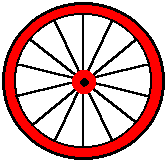
Finally, when you get hooked on spoke counting like I am, here’s a little tip which will save you time. Only count half way round. Now you may think this is obvious; when you’ve counted half way round and you’ve got up to 8, you double it making 16 and that’s the number of spokes; wrong! If the halfway round total is 8, it’s a 14 spoke wheel. This is because all cart wheels have an even numbers of spokes so there is always a spoke diametrically opposite a spoke. If you start at the top, for example, and you count round to the opposite spoke at the bottom, you will have counted half the number of spokes plus one. Don’t believe me? Try counting the one below, and you will see that I’m right. So, the half way round counting rule is as follows: 7 is a 12 spoke wheel, 8 is a 14 spoke wheel and 9 is a 16 spoke wheel. Happy counting! Phil Stephens
|
|
| Next
page Previous Page Home |
|
