|
Bell Ringing, What Is It All About? (Continued) |
|
|
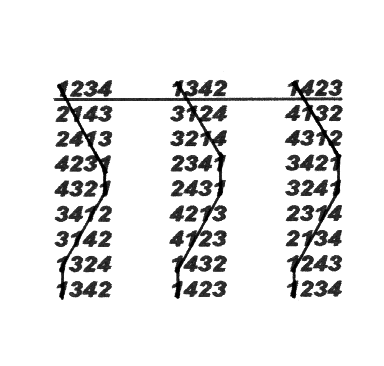
Rounds, call changes and change ringing When ringing commences the bells are rung in consecutive order down the scale. This is termed as ringing in >rounds=. That is from the lightest bell round to the heaviest bell, i.e. 12345678. To vary the sound, changes in the order are >called=. The conductor (the person in charge of a particular piece of ringing), changes the place of two adjacent bells and may call out A7 to 5@ whereupon the 7th follows the 5th and the 6th the 7th (i.e. 12345768). Natural progression is to >change ringing= where the bells change order at each pull to a pre-ordained path. The following pattern, where the path of the treble is clearly marked, is one of the simplest ways of listing all of the 24 permutations on 4 bells and is called a plain course. |
 |
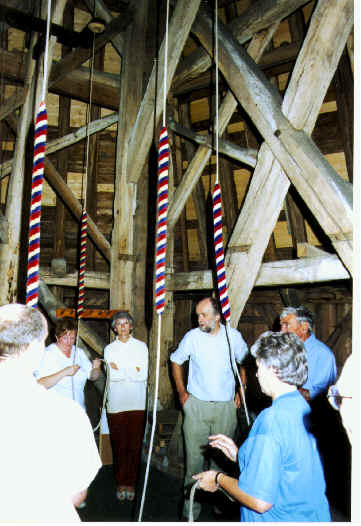 The Bellringers in St Augustines Kent |
The tunes are known as >Methods=; many with curious names like Grandsire or Reverse Canterbury. The term following the name denotes the number of bells being rung e.g. Doubles is rung on 5 bells, Minor on 6, Triples on 7. A >quarter peal= consists of a minimum 1,260 changes and takes about 45 minutes to ring. A >peal= consists of a minimum 5,000 changes and takes about 3 hours to ring. There have been over 150 peals rung at Writtle since 1811. 8 bells have only been rung once to their full extent of 40,230 changes by the same eight men and required 18 hours non-stop ringing.Guilds and Societies Throughout the country there are county or diocesan Guilds and Associations as well as >specialists= like the Society of Rambling Ringers. Some have misleading titles like the Ancient Society of College Youths. The >Youths= represent some of the best ringers in the country and perform on state occasions at St Pauls and Westminster Abbey. The Essex Association of Change Ringers was formed at Writtle in 1879. The Association has about 1,000 members. |
|
Ringing for the Millennium In September 1997 the Open Churches Trust and the Central Council of Church Bell Ringers launched a campaign to recruit and train enough ringers to ensure that as many church bells as possible might ring out for the Millennium. We aim to ring all the bells in Essex for a special service of thanksgiving on 1 January 2000. As part of this project the SE District of the Essex Association, of which I am Master, started a Ringing School to teach new recruits how to handle a bell and ring rounds and call changes. We teach every Saturday morning either at Writtle or at Terling. To date we have taught 30 new recruits and are currently teaching a further 10.How could I become a ringer....... You don't need any qualifications, you don't have to be big, strong or musical, you don't need to buy any expensive equipment, and you don't have to be a regular church-goer. The principle object of the exercise is to achieve good striking with no gaps or clashes by pulling the ropes faster or slower. You should be prepared to spend up to an hour ringing on Sunday mornings, and a weekly evening practice is essential. Any more is optional, if you can spare the time. However, be warned, bellringing can become addictive! |
|
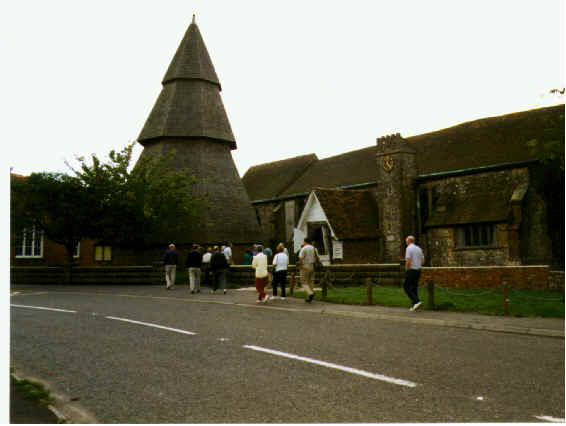 St Augustine’s Church in Brooklands Kent |
....... and where could I ring? If you are interested in keeping the ancient and distinctly enjoyable tradition alive, why not come and see us on practice night (Tuesday=s from 7.30pm) or introduce yourself to one of us in the Wheatsheaf after practice. There is no obligation - you may even get the chance to have a go, under strict supervision of course. The ringing of church bells is such an important part of our heritage that we must not let these bells remain silent. ANDREW BREWSTER |
|
|
Next page Previous page Home |
|
